

Scene Mat TCAW #7
Mrs. Santa (Lydia Brazzi), Santa Claus (Albert Rablagiati), Mr.
Whipple (Paul Tripp), visit mean Mr. Prune (Rossano Brazzi),
on Christmas Eve in a scene from Childhood Productions East-
man Color classic "The Christmas That Almost Wasn't."
"The Christmas That Almost Wasn't"
A Colorful Package of Entertainment
The delightful, new musical fantasy, "The Christmas That Almost Wasn't," opening .......at the .......... Theatre, is an entertainment treat that is as colorful and cheerful and as full of surprises as the most spirited of holiday seasons.
The humorous and touching Christmas story, produced by Barry B. Yellen in Eastman Color, is the first full-length feature to be made under the auspices of Childhood Productions, a leading distributor of family films through which the new attraction is released. It also marks the directorial debut of the romantic screen idol, Rossano Brazzi.
Filmed in English in Rome, Italy, a reflection of its international appeal, the production stars Brazzi, Paul Tripp, Lydia Brazzi, Alberto Rabagliati, Mischa Auer and Sonny Fox.
Tripp, who wrote the original story and screenplay and the lyrics for the picture's sparkling songs with music by Ray Carter, has for many years been known for his celebrated, special touch in the field of children's TV entertainment. He has created, written and starred in the innovating, award-winning trio of television successes, "Mr. I. Magination," "On The Carousel" and the current "Birthday House."
All of those shows also have benefited from the melodies and expert musicianship of Ray Carter. Lyricist Tripp and composer Carter have collaborated happily for more than twenty-five years, and their latest songfest for "The Christmas That Almost Wasn't" is indeed a highlight in the prolific team's career.
In the story which so bountifully combines fantasy, music, laughter and suspense, Santa Claus, portrayed with robust energy by Rabagliati, is threatened with eviction from his home and toy factory in the North Pole. His antagonist is Phineas T. Prune, an ill-tempered zillionaire who hates Christmas, a characterization by Brazzi in a daring departure from his memorable, romantic heroes.
Charming scenes in Santa's workshop involve the actor's wife, Lydia Brazzi, in her screen debut as Mrs. Santa, and Santa's helpers, the elves, whose yuletide preparations are interrupted by fits of depression over the possibility that there may not be any Christmas gifts for children that year.
Tripp is seen as a devoted friend of Santa's who tries to help him out of his difficulties. Another television star, Sonny Fox, is a department store owner who is persuaded by Tripp to begin the tradition of personal appearances by Santa in store toy departments. Auer returns to the screen in an inimitable comic portrayal, that of Jonathan, Santa's chief clerk and foreman of the elves.
Everyone's efforts to save Santa from eviction, however, seem doomed to failure, until the children of a small town decide to take matters into their own, little hands. The children's spirit and generosity, in the end, even serve to reform the villain and Santa is able to deliver his gifts and good cheer throughout the world, as always. "The Christmas That Almost Wasn't," in which producer Yellen appears in a cameo role, has a background score by one of Italy's top composer-conductors, Bruno Nicolai.
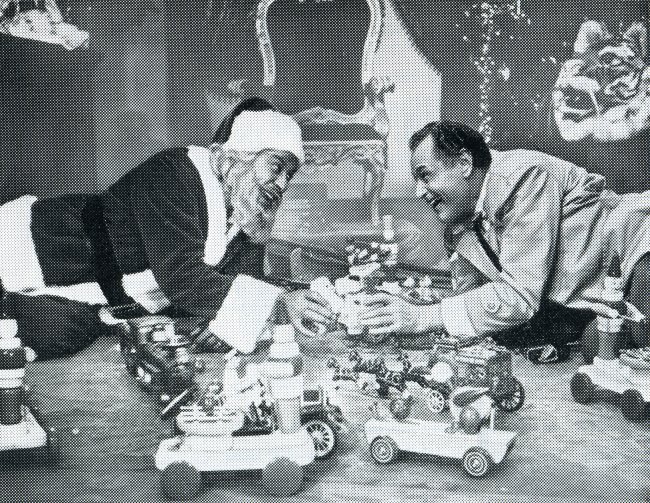
Scene Mat TCAW #1
Sabta Claus (Albert Rabagliati) and Mr. Whipple (Paul Tripp) share a moment playing with
some Christmas toys in a scene from Childhood Productions Eastman Color classic "The Christ-
mas That Almost Wasn't."
"Christmas That Almost
Wasn't" Has Mr. and
Mrs. Santa Claus
It is a tale in the traditional sense, except that Santa Claus gets somewhat modernized. He still has a beautiful white beard that frames here the bright shiny happy face of Alberto Rabagliati; but he also has a wife (in real life she is actually Rossano Brazzi's wife) and he has hired an accountant, the incomparable Mischa Auer.
Brazzi had nothing to do with the fact that Mrs. Brazzi is one of the main characters in the film, it was the producer's choice. In fact, the first few days the director was really bullying her around, although this is almost her first part. "She is so intelligent that she gets upset if she cannot almost guess what is expected of her" explains Brazzi, "and I didn't realize that if you're not a professional, everything is so much harder, this is my hundred and ninth film, while she has only acted a couple of times. When we were students at the Venice University, we used to organize some plays to make a little money. We had with us Zefferelli who was like us, a law student and Arnoldo Foa who was studying architecture."
While Mrs. Brazzi is building up her name as an actress, Rossano seems to have settled behind the camera. In his next film too, he will be the director.
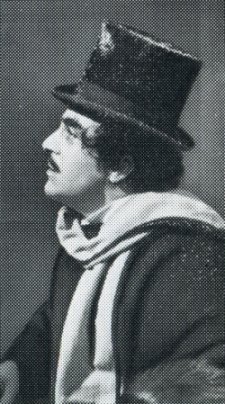
Scene Mat TCAW #10
Rossano Brazzi, co-star and di-
rector of Childhood Produc-
tions Eastman Color Film,
"The Christmas That Almost
Wasn't." This is Rossano Braz-
zi's directorial debut.
Biography
(Director and Star of "The Christmas
That Almost Wasn't")
Rossano Brazzi, symbol of the romantic screen lover to women throughout the world, has taken two adventurous giant steps down new paths as a star and director of "The Christmas That Almost Wasn't."
The handsome Italian leading man departs completely from his past portrayals to create the character of Phineas T. Prune, an ill-tempered villain who wants to put an end to Santa Claus and to Christmas giving, but who finally reforms and proves to be human after all. The original story and screenplay which coaxed Brazzi to perform behind the cameras, too, was written by Paul Tripp, creator of the award-winning television shows for children, "Mr. I. Magination," "On The Carousel" and the current "Birthday House."
He was called to Hollywood to star in the remake of "Little Women," but the role was not particularly right for him and that first trip to America was less than auspicious. Then, at the end of World War II he starred opposite Katherine Hepburn as the romantic and aristocratic Venetian in "Summertime." This time the combination of Brazzi charm and the right role clicked loudly and brilliantly with American audiences. The movie was a tremendous critical and popular success, and his performance drew applause and more and deeper feminine sighs in all parts of the globe.
He has always considered Rome to be his home, despite frequent trips to Hollywood, and has continued to make pictures and appear on major television shows in Italy. Altogether, the star has made one hundred and eight films, and after his years as one of the screen's leading romantic figures, he was anxious for a change and a move forward, into direction and into a new direction in acting.
In his first film as a director, the former "latin lover" is in opposition with his traditional character.
A moustache drooping down the sides of his mouth, shaggy yellowish rising eyebrows, a night bonnet and a baggy short nightgown revealing bony, hairy knees when he sits down. This is Rossano Brazzi as he pictures himself: Ugly, at last!
"To be handsome, always too handsome…at the end it is unbearable" says Brazzi. "In America, it's worse, it's disastrous when you're very popular," The last time he went there, he had three "incidents" in a few days. One afternoon, as he went to a TV recording, some secretaries assistants and hostesses ran after him, wildly screaming for autographs, breaking a glass door in the process. Another evening, in a restaurant he had to escape through the back door. He says that even for Tony Curtis who had been there three days earlier the "fans" didn't get that wild.
Whatever the ingredients for his success are, Rossano Brazzi as a director is in complete opposition with Brazzi as a "latin lover." The first chance he had to choose a part for himself, he dismissed the character of the overly smooth, handsome and strong "still young" man he used to play and chose to be a villain in a tender comedy.
"The Christmas That Almost Wasn't" also boasts the film acting debut of Brazzi's wife, Lydia Brazzi, and also stars Paul Tripp, Alberto Rabagliati, Mischa Auer and Sonny Fox. Featuring original songs by Ray Carter with lyrics by Tripp, the background score, orchestration and musical direction are by Bruno Nicolai.